The following is my peanut box for articles relating to multi-media, tools, technology, and various topics of the nerd persuasion. If the nerd is strong with you, read on.
The Red Hydrogen: Rube Goldberg Phone or Sweet UFO Technology?
01/28/2018 – By Joseph Dean McDonnell
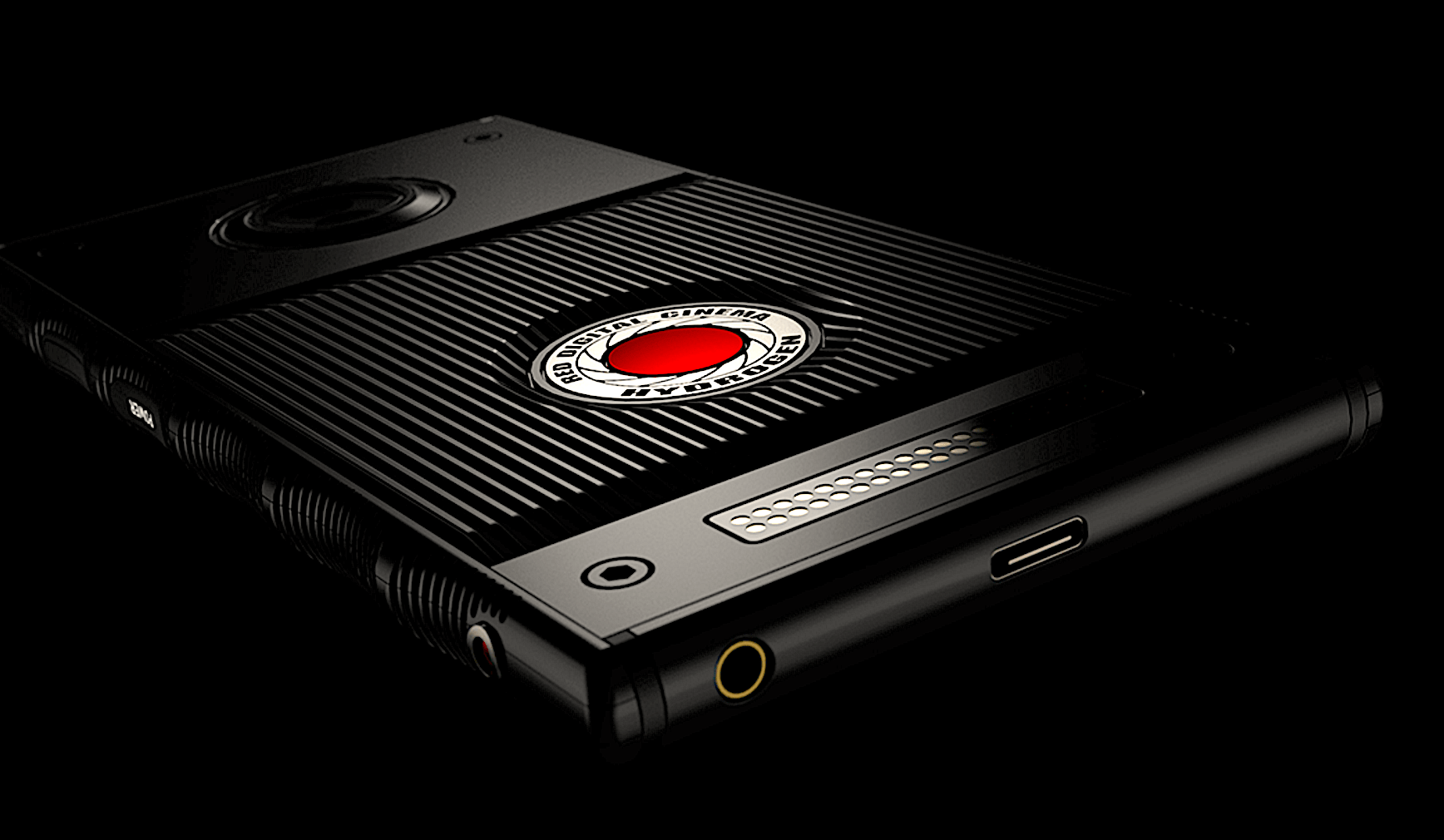
Many may be unfamiliar with the company RED, but for much of the past decade they have, for better or worse, brought Hollywood cinema cameras into the digital age. Now the company is directing their engineering chops at another technology: the cell phone. In a post on the company forum, RED CEO Jim Jannard said that carrier support is “unprecedented,” and perhaps that exuberance denotes all major carriers, although specifics are still not known. RED has stated that the Hydrogen One will have an Android operating system with a 5.7-inch, 2560 x 1440 display, a 4,500mAh battery, USB-C and microSD card support, a headphone jack, dual front and rear cameras, and a Snapdragon 835x processor. All good features, but nothing scintillating from the competition.
Their two-front strategy for disruption describes a modular phone with a holographic display and an upgradable camera attachment. At a glance, the phone body looks like something Kylo Ren would use to assail Jedi-folk. The screen can display normal 2D media, stereo 3D, augmented reality, virtual reality and mixed reality, without additional glasses or headsets. Jannard says, “The 4V files match the pixel resolution of a traditional 2D file, which is great for downloading. The resolution perception is just different. The horizontal resolution of 2D is now split into depth layers. It gives a completely different feeling. All the pixels are there… but instead of ‘looking at’ a pic, you are immersed in the image.” In 4V mode (4-view or holographic), the screen dims a bit and out pops a holographic image… no glasses needed. Evocative, if nebulous marketing may fail to elicit the state of nirvana that Jannard transcribes in using the phone.
As professional photographers and cinematographers will attest, the vast majority of cell phones capture fair images at best, with very little control over creative settings. They lack quality lenses as well as the sensor size for high resolution, dynamic range or low light capabilities. That is where RED enters the scene with deep experience in image technology. The phone’s modular design will let you stack battery modules with a “cinema grade camera module” among others. The camera module will allow recording of high quality RAW video in RED’s R3D format, but will only support recording 2D footage. Additional modules for improved 3D and 4V filming are in the works. RED is also building out a “Hydrogen Network” that will collect 4V video from “major studios and other content providers.”

Jannard slings superlatives with the best of them, but seeing is believing. The holographic screen could be a nifty feature addition, but it may play a bit part if RED can successfully marry professional camera components with the portability of phones. RED could change the landscape of both industries, siphoning from the premium phone and mirrorless camera markets. According to RED, the Hydrogen phone will enter production and begin shipping summer 2018. A Hydrogen Day is planned for April at RED Studios to preview the technology and demonstrate how to become a content provider.
The Curious Case of the New Kodak Super 8
01/03/2018 – By Joseph Dean McDonnell

In the last decade, motion picture film has increasingly become a format for darlings of Hollywood. People often say that there’s some intangible quality, a feeling that film evokes. It has an intrinsic ability to forgive flaws, and the color is still unmatched. Recently, Kodak has been developing a Super 8 film camera to stoke new interest in the medium. The camera has an appealing hardware design by Yves Behar, with a cartridge system that loads like something to combat bad dudes in Tron.
The call to use Super 8 film gives me pause to question whether the product was conceived solely to ride the buzz of 1980s throwback culture like Ready Player One. But since I am a suckah-face for anything that remotely resembles an Atari laser blaster, I will play along with the kitch factor. It’s hard not to root for the camera, but what is disenchanting is the format to price-point ratio. One of the things that was so great about these lo-fi films was the lo-fi price. In the latest press release, the sticker will go between $2500 to $3000.
So who is the new camera designed for? Given the format, it seams poised for students, artists, and family photographers, but with a tragically comic price to pay for the novelty of Spielbergian nostalgia. Image resolution is generally a fundamental difference between lower and higher priced cameras, and it is limited with Super 8. Indeed, the camera seams purpose built for images that elicit grain and evoke the golden era of home-made films. If the camera is meant to galvanize imaginations of budding filmmakers like those in the movie Super 8, then the product should be attainable for that demographic, which might be ten percent of the stated MSRP.
If Kodak stays with the current price structure, it becomes a pricey gimmick, rather than a fun tool. Perhaps if the camera was designed for a Super 16 format, the bump in resolution could attract more professionals, film schools, and artists to put it to use as a creative tool. If they change the format or price philosophy, they could have something memorable that finds a place in the hearts and minds of many, instead of falling on the garbage pile of defunct electronica.
If Kodak wants to make film popular again, it needs to decide if it’s making a tool or a toy.
The Future of Nikon vs. Canon
05/03/2016 – By Joseph Dean McDonnell

There are 2 types of cameras in most electronics stores: the consumer variety and the professional grade cameras. Business for consumer cameras has dried up largely due to the abundance of phone cameras. And by no coincidence, for better or worse, saturating your social feeds with cat pics and flexing beefaronis. After Canon introduced video in the DSLR camera market almost a decade ago, innovation in professional cameras slowed to a drip.
In recent years, most camera innovation shifted to consumer technology and improved how photographs could be shared to mobile phones or social accounts. These days, many cinematographers work as photographers and vice versa. They have to stop on a dime, switching between time-based or still-based mediums, and rarely have the affinity or the capacity to carry two cameras, to support pro video and still photography formats.
As the photographer and cinematographer have coalesced, there is a strong need for a camera that can do it all. Looking forward, camera companies should place the focus back on improving images and integrating higher quality video capture settings in their professional cameras, like the D810 and the D750. This shouldn’t necessarily reflect buzz-numbers, like lines of resolution: 6K, 8K, 16K. One of the few areas of drastic image improvement has been high resolution. Nikon is in a unique position to improve video in their pro cameras because Canon and Sony have business windows strictly devoted to building professional video cameras, and they don’t want to undercut one of their own departments, thus inhibiting their growth in camera development.
Nikon’s 2016 release of the D500 has again increased video resolution and ISO sensitivity ratings, but in demo videos it’s easy to tell the color is still lagging. Canon’s 7D and 5D series cameras both suffer from the same lack of color depth and dynamic range, limiting any kind of video post-production. Meanwhile, a small Australian company has built the affordable Blackmagic Pocket and Cine cameras that output stunning RAW video, albeit at a slightly lower resolution. Although it has suffered from quality control issues, the video images have been promising. If Blackmagic were to add professional photo features to their camera lineup, they might have a contender.
A big part of the quality discrepancy between current digital photos and video amounts to color depth. Looking at a RAW still photo, one can easily observe the color is far richer, and more organic than a h264 compressed video frame. Nikon’s focus should be on implementing RAW video and 4:2:2 bit internal video capture settings with their new professional line of cameras. Professionals and aspiring visual artists need a camera worthy of the revolutionary title belt. If Nikon builds it, they will come.
 Pxlero I Joseph Dean McDonnell